
Step 3: Sensor Setup
Before hooking up the sensor to the equipment, we need to first fill the sensor with conductive fluid. In this guide, we use 5 %wt saline solution, which is simply 5 parts salt to 95 parts water by weight.
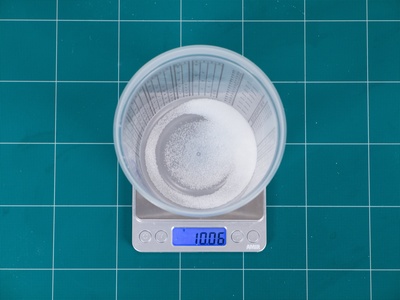
| Weigh 10 grams of salt in a container |
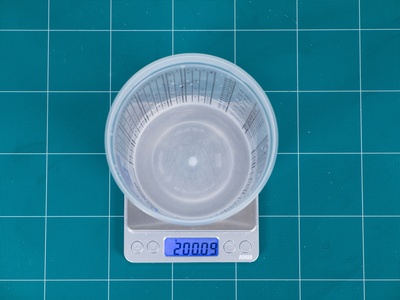
| Add 190 grams of water to total of 200 grams of solution. Filling the sensor only requires about 5 ml of saline. The solution is prepared in bulk due to the ease of weighing. |
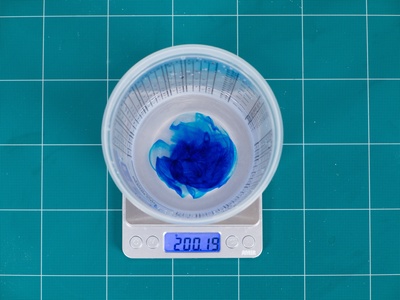
| Add 3 drops of food coloring. Coloring the saline is important for checking for air bubbles within the sensor. |
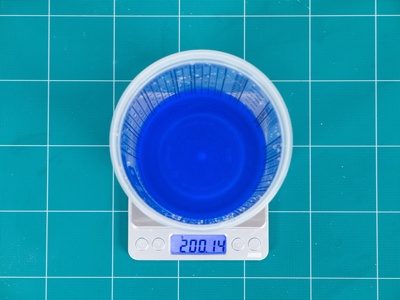
| Stir well until the solution is homogeneously colored. |
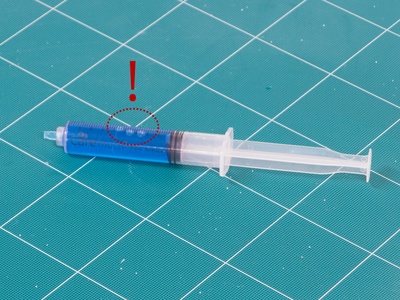
| Using a syringe, pull about 9 ml of the solution. There will be some air bubbles along with dissolved gasses within syringe. Follow the instructions in this video to vacuum degas the bubbles. Of course, vacuum degassing the whole container is also fine. |
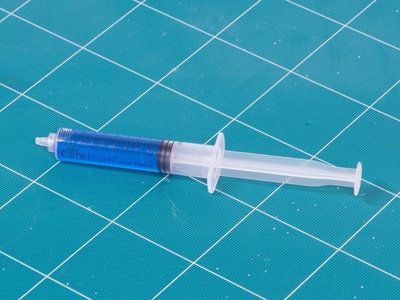
| Once degassed, the solution is ready to be injected into the sensor. |
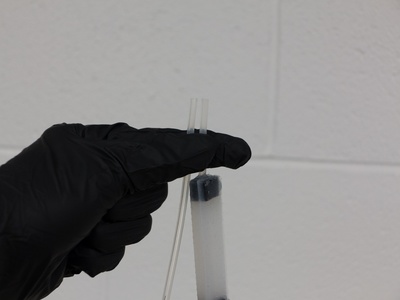
| Hold the sensor up at the ends of the silicone tubes in to a "U" shape like shown. Doing so will prevent air bubbles from being trapped while filling the sensor. |
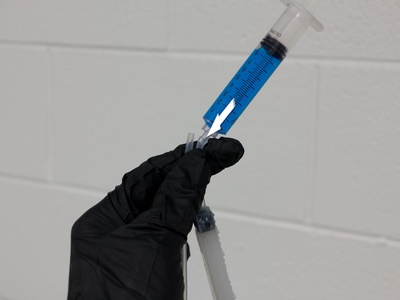
| Slide the syringe tip into the short end of the sensor. |
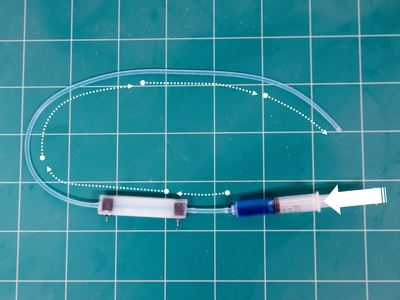
| Slowly fill the sensor by depressing the syringe plunger in short strokes while staying vertical. |
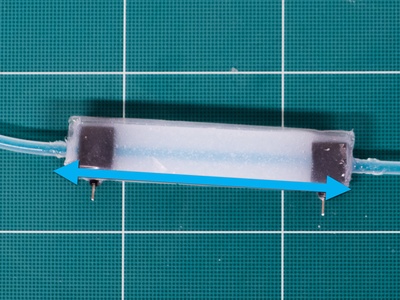
| Make sure there are no air bubbles between the two conductive ends within the sensor body. Refill if necessary. |
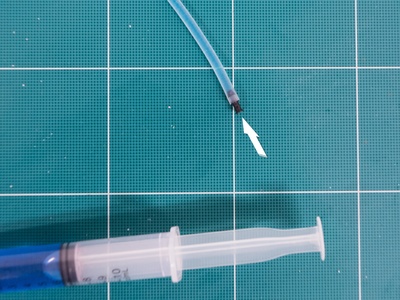
| Plug a stopper in one end of the sensor, remove the syringe and plug in another stopper at the other end. |
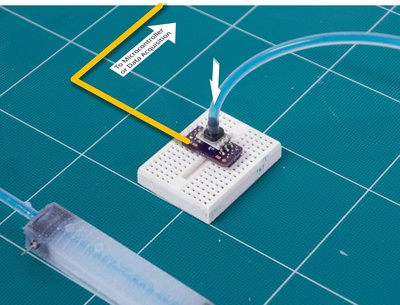
| Remove the plug from the longer silicone tube and plug the tube into the pressure sensor. Squeezing the end while inserting the tube will ensure that air is not trapped between the pressure sensor and the fluid. The images here are for illustrative purposes only. Please wire up your hardware accordingly. |
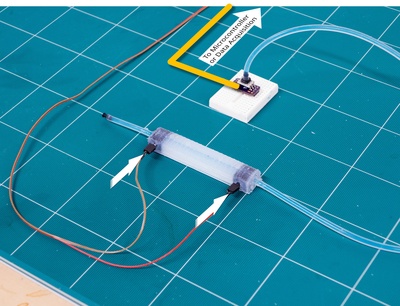
| Plug in leads from the voltage divider circuit or data acquisition hardware. The images here are for illustrative purposes only. Please wire up your hardware accordingly. |
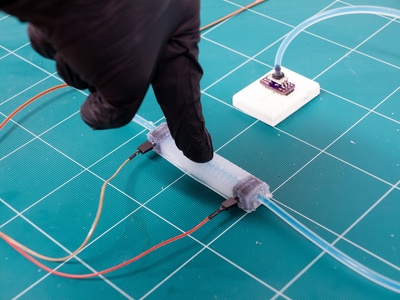
| The sensor is now complete and ready to be used! |
Bibliography
Preechayasomboon et. al. Multi-Modal Sensing and Actuation in Biomechanical Hydraulic and Pneumatic Systems.
Contributors
Pornthep Preechayasomboon
Gaurav Mukherjee
Eric Rombokas